
Balloon Catheters
Catheters are used when the natural emptying of the bladder via the urethra does not work anymore or only very limited.In this case, we distinguish between the transurethral (through the urethra) and the suprapubic (through the abdominal wall) bladder drainage.
Transurethral bladder drainage
In transurethral bladder drainage, a catheter is pushed through the urethra into the bladder. The front part of the catheter is located in the bladder and is fixed there with the help of a balloon, while the rear part is protruded out of the urethra and connected to a urine bag. To change the catheter, the balloon filled with a glycerine solution is emptied via an external valve and the catheter can be pulled out of the urethra.
Transurethral bladder drainage is the most common catheterisation. Their disadvantage is the susceptibility to bacteria that find an ideal breeding ground between catheter outer wall and urethra and can lead to urinary tract infections.
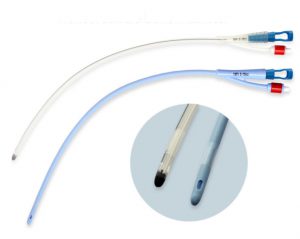
Data Sheet Transurethral Balloon Catheter
Suprapubic bladder drainage
With the suprapubic badder drainage, a splitable stainless steel cannula (outer diameter 4.6 mm or 5.6 mm) punctures the bladder from the abdominal wall and the catheter is pushed over this access into the bladder. The fixation in the bladder via a balloon as well as the other emptying and connection options correspond to the largely identical transurethral catheter.
To change the catheter, an exchange wire is pushed through the catheter into the bladder. Over this wire the old catheter is pulled out and a new catheter is pushed into the bladder.
